Leadership and Governance in early years.
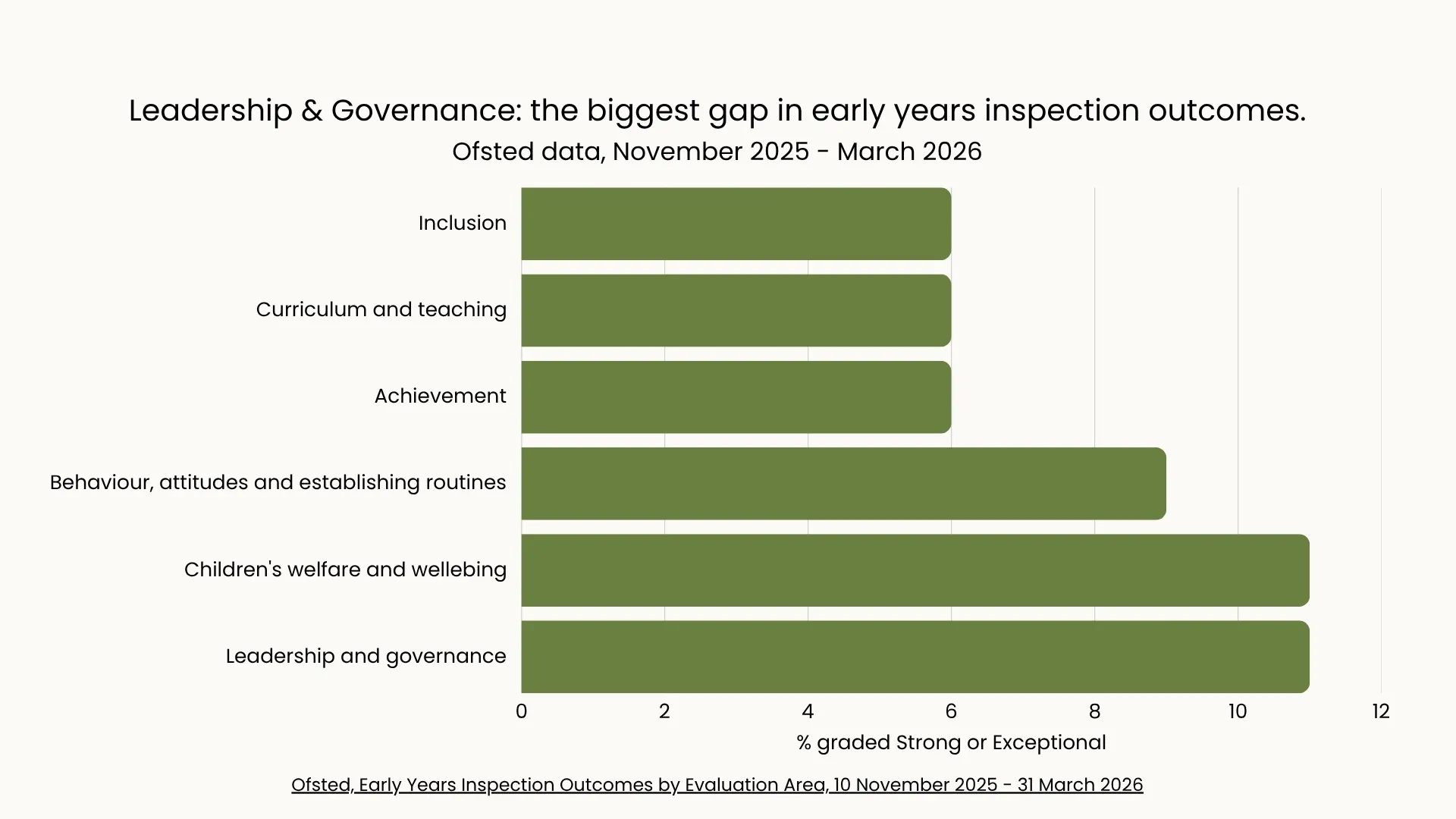
Ofsted published its latest inspection data this month, covering November 2025 to March 2026 , the first data release under the renewed inspection framework. Across all six evaluation areas, one stood out and not for the right reasons.
Why the gap is real and what to do about it.
Leadership and Governance had the lowest proportion of Strong grades of any evaluation area, just 31%. It also had the joint highest proportion of Urgent Improvement or Needs Attention grades at 11%. In contrast, Behaviour, Attitudes and Establishing Routines and Children’s Welfare and Wellbeing both achieved 45% Strong grades. The gap is significant and it is consistent across provider types.
Of 1,720 full inspections carried out between November 2025 and March 2026, only 31% of settings achieved Strong in Leadership and Governance.
I am not surprised. And I say that as someone who has been on both sides of it.
I have worked in early years for over fifteen years including as a nursery manager, as an area manager responsible for multiple settings, and now working at Get Otii. The leadership and governance gap is not new. It is not a reflection of how much leaders care. It is a reflection of how hard it is to lead confidently when the information you need is scattered across spreadsheets, folders, HR systems, shared drives, and people’s memories.
This is what that actually looks like from the inside.
The reality of oversight
When I was an area manager, staying on top of things across multiple settings was a full-time job within a full-time job.
There were spreadsheets, multiple versions, updated at different times, not always in sync. There were visits to settings, calls with managers, fragmented systems that did not talk to each other. Records sitting in HR that I could not access easily. Documents in folders, some physical, some digital, that different people were responsible for keeping up to date. Printed policies that may or may not have reflected the latest regulation. Procedures that had been updated centrally but not cascaded consistently to every room.
And underneath all of it, the constant work of keeping up with regulatory changes, new EYFS updates, Ofsted toolkit revisions, safeguarding guidance and making sure every manager, in every setting, knew what had changed and what needed updating.
That is the reality of early years leadership at scale. It is not a failure of commitment. It is a structural problem, one that the sector has largely accepted as just how things are.
The leadership and governance gap is not a reflection of how much leaders care. It is a reflection of how hard it is to lead confidently when the information you need is scattered.
The moment I remember most
I will not go into specifics. But I remember an inspection I covered as an area manager while a setting’s manager was on annual leave.
The setting was genuinely good. The practice was strong. The team were doing everything right. But when the inspector asked for specific documents, I had to make calls. I had to search through folders that were not mine to navigate day to day. There was a staff record for a newer member of the team that had not been properly filed yet, it existed somewhere in the system, but in the moment, standing in front of an inspector, I was not sure where.
What was going through my head in that moment was not a professional calculation about risk or compliance. It was simpler and more honest than that.
I really hoped we had it somewhere.
The inspection was fine in the end. But that hope, that anxious, crossed-fingers hope, is not how confident leadership feels. It is not what good governance looks like. And it is not something any leader should have to carry into an inspection.
The most important thing I took from that day was this: the knowledge, the records, the evidence of good practice, none of it should live with one person. The moment that person is on leave, on sick, or simply not in the room, the whole picture disappears with them.
That is not a people problem. It is a systems problem.
What was going through my head was not a professional calculation. It was simpler and more honest than that. I really hoped we had it somewhere.
Why the Ofsted data is not surprising
When I look at the data showing Leadership and Governance as the weakest area, I think about what Ofsted is actually asking for.
They are not just asking whether a leader knows their setting. They are asking whether a leader can demonstrate that they know their setting, in the moment, under pressure, with evidence that is visible, current, and accessible.
In early years, that is genuinely hard. No two days look the same. Leaders are managing staff, supporting practitioners, responding to parents, and making sure children are safe all at once. The time available for structured oversight, for organised record-keeping, for the kind of governance that looks confident under scrutiny, is limited.
And when the systems available are fragmented, when the information lives in ten different places and nobody has a single clear view, the leadership gap is almost inevitable. Not because leaders are not trying. Because the infrastructure does not support them.
What Ofsted is measuring in Leadership and Governance is not effort. It is infrastructure. And most settings in early years do not yet have the infrastructure they need to perform confidently in this area — not because they cannot build it, but because nobody has given them the tools to do it.
The leadership and governance gap is not inevitable. It is a systems problem and systems problems have solutions.
What confidence actually requires
Confident leadership in early years is not about knowing everything. It is about being able to find everything and knowing that when someone asks, the answer is already there.
That requires visibility. Real visibility, not a spreadsheet that was last updated three weeks ago, not a folder that may or may not be current, not a call to HR hoping the document was filed properly.
One place. Accessible to everyone who needs it. Updated when something changes. Showing what is current, what is outstanding, and what needs attention before anyone has to ask.
That is what changes the feeling of walking into a governance conversation or an inspection. Not more preparation the week before. Not a better filing system. Infrastructure that works quietly in the background every day — so that when the moment comes, the answer is already there.
The settings that perform most confidently in Leadership and Governance are not the ones with the most experienced leaders. They are the ones with the clearest picture of their own practice, at any given moment, without having to chase it down.
Confident leadership is not about knowing everything. It is about being able to find everything and knowing that when someone asks, the answer is already there.
What I would say to any leader who recognises this
If you read this and recognised something, the spreadsheets, the fragmented systems, the moment of hoping the document is somewhere, you are not alone. This is the reality for the vast majority of early years leaders. The Ofsted data confirms it.
But here is what I know having spent fifteen years in the sector and now building a platform specifically designed to solve this problem.
You do not have to carry it all in your head. You do not have to hope.
Technology exists to do this work. Not to replace your judgement or your leadership but to hold the information, track the records, flag the gaps, and give you the visibility you need to lead with confidence rather than anxiety.
The leaders I have seen, operate most calmly in inspections, in governance meetings, in the ordinary Tuesday morning when something unexpected happens, are not the ones who worked harder or prepared more. They are the ones who trusted their systems to hold what they could not hold themselves.
You are not alone in this. And you do not have to manage it alone. Trust technology to work in your favour. Let it carry what it is built to carry — so you can focus on what only you can do.
You do not have to carry it all in your head. You do not have to hope. Trust technology to work in your favour.