What the SEND white paper actually means for nurseries
I've read a lot of government documents about the early years. Most of them are about us rather than for us, and you can usually tell within a page. This one is different, and I want to be specific about why.
The Department for Education's white paper, Every Child Achieving and Thriving, states that the early years have long been regarded as lower in status — "treated as an optional add-on rather than an integral part of the education system."
Their words. Not mine. Twenty years I've been making that argument in rooms where it didn't land, and it turns out you just have to wait for a policy paper to say it back to you.
So. Now it's written down. The question is what happens next, and specifically what happens next in your setting.
First, our approach to education must shift from narrow to broad. Past governments' narrow focus on what happens only within the school gates will be replaced with a broad vision for childhood, from the day children are born to their transition to adulthood. Our ambition for high-quality education therefore starts in the early years, where the foundations of future success are laid.
Every Child Achieving and Thriving, Department for Education, 2026
The bit aimed squarely at nurseries
Most of the coverage of this white paper has been about schools. That focus is needed — the SEND system is in genuine crisis and the pressure on mainstream schools is the sharpest end of it.
But there are commitments in here that land directly on early years providers, and the sector is not talking about them nearly enough.
A proposed statutory duty to record and monitor SEN support.
The white paper sets out a duty on nurseries, schools and colleges to record and monitor a child's special educational needs and the provision made for them, in an Individual Support Plan.
Read that again if you run a setting. A duty. To record. And monitor.
I want to be careful here, because I've seen a lot of confident nonsense posted about this already: it is a proposal in a white paper, published alongside a live consultation. It is not law yet. But governments do not put this kind of commitment in writing and then quietly forget about it, and the direction is not ambiguous.
Money attached to inclusion.
An Inclusive Mainstream Fund of £1.6 billion over three years. A new Inclusive Early Years Fund specifically to help providers identify and respond to emerging additional needs. A new Experts at Hand service designed to get speech and language therapists and educational psychologists to children earlier.
A timetable that is closer than it looks.
Preparation for SEND and curriculum reform runs from the 2026 to 2027 academic year. Full implementation from 2028 to 2029.
That feels comfortably distant right up until you ask yourself what you'd currently hand over if a local authority asked for two years of documented SEN provision for a specific child.
The trap in all of this
The white paper is unusually honest about why the current system fails children. Support arrives late. It's rigid. It sits behind bureaucratic processes. And the professionals who should be with children — educational psychologists among them — are instead buried in paperwork.
That's the diagnosis, and it's correct. Which is exactly why I'm watching the ISP proposal so carefully.
Because there is a version of this where a duty to record and monitor SEN provision lands on a sector already running on thin margins and thinner hours, and simply becomes another layer of the thing the white paper has just finished diagnosing.
Early years staff are not short of care. I've never once met a practitioner who didn't care. They are short of hours, and they are short of anywhere sensible to put what they know.
Here's what that looks like in practice right now. A child's early support history lives in about six places at once. A paper file in the office. A practitioner's memory of a conversation at pickup. An observation notebook. A referral form somebody photocopied. A parent's own account, which nobody has formally written down. Then the child moves to school, or a local authority asks what's already been tried, and almost none of it can be handed over in a usable form.
So everyone starts again. From nothing. With a three-year-old who has already waited.
That's the gap the new duty is going to land on top of.
What we've built so far
I built Otii because I ran nurseries for twenty years and spent an unreasonable proportion of that time doing the backend rather than the actual job. Policies. Safeguarding records. Training logs. Evidence. Inspection prep. Nine systems, none of which spoke to each other, all of which needed me.
It started as a SaaS product. It has ended up an operating system for running a setting.
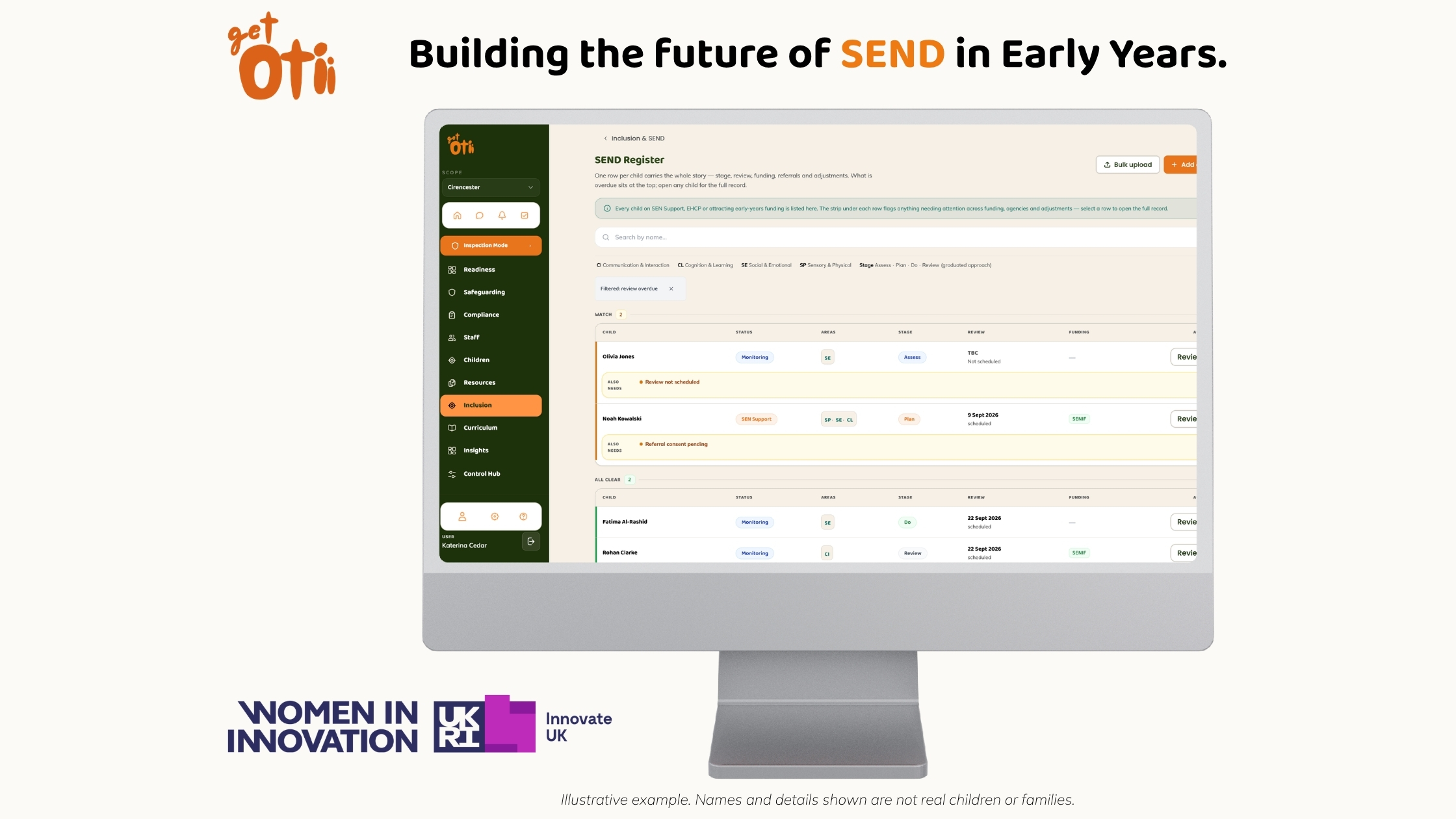
Inside it sits the Inclusion Hub — the SEND register, the graduated approach of assess, plan, do and review, inclusion assessment, and the flags that route to the right person rather than sitting in someone's inbox.
It works. I'm proud of it. It also stops at the nursery door.
Everything Otii holds about a child's inclusion journey is beautifully organised and completely trapped inside one setting. Which is fine, right up to the moment the child needs somebody outside that setting to understand them.
What the grant is for
Get Otii has been awarded an Innovate UK Women in Innovation grant to take the Inclusion Hub out of the building.
Three things we're testing, honestly, with the possibility that some of them don't work:
One workflow a practitioner can actually follow.
The graduated approach turned into a clear sequence of steps, rather than a folder of guidance to interpret alone at 6pm after a ten-hour day.
The parent brought in early, and gently.
When a child is first flagged, families hit a wall of information at precisely the moment they are most frightened. I've sat in those meetings from both sides of the table. We want to find out whether a simple, human parent loop can take fear out of those early weeks rather than adding to it.
One record instead of twelve.
Documentation that the professionals around a child can read as a single picture, and that follows the child into school rather than being rebuilt from scratch. If that record reaches a local authority or an external agency in a format they can actually read, the question we want answered is whether the timeline shortens.
Where the line is on AI
Some of this involves agentic AI, and I want to be precise about it, because what’s on offer right now for the early years sector has not been built with the care this space needs.
AI can carry documentation weight. It can translate an observation a practitioner has written into the structure a system expects. It does not diagnose. It does not decide. Every output requires human confirmation before it goes anywhere near a record.
Less paperwork. Not less judgement. That's the line, and we don't cross it.
What happens next
I don't know if all of this works. That is genuinely what a test is for, and it's why grant funding matters — it pays for finding out, which is not something most funding does.
But I'd make one argument to the sector directly. The reforms are coming. The documentation expectations are coming with them. Settings can either get ahead of that now, while there's funding and preparation time attached, or meet it in 2028 with a paper file and a filing cabinet.
Early years is first in line in a child's education. Just once, it would be good to be first in line for the support as well.
We'll publish what we learn. Including the parts that don't work.